-
CONSERVATION
Give Owls & Bats a home

OWL HOUSES
FROM: Birdlife.Org "Owl nesting boxes are constructed from standard, tongue and groove pine ceiling boards, on a 30mm x 30mm pine frame. Ask your timber supplier to supply the wood untreated, as household timber is normally treated with a poisonous insect repellent.
The two types of boxes are in essence the same, with the exception that the access hole is restricted to one small hole in the case of the Barn Owl (photograph above left), and large access holes in all four sides in the case of the Spotted Eagle Owl (photograph on right, box on the right). In both cases, the bottom of the access holes should be positioned so that the baby birds cannot fall out of the box.
A small landing area (15cm x 10cm) should be attached to the Barn Owl Box at the base of the access hole. The roof slopes towards the small front in the Barn Owl box, whilst the roof slopes the other way in the case of the Spotted Eagle Owl box. In both cases, the roof overhangs the sides by 5cm to give more weather protection. The wood in both types of box is treated on the outside only with a good lead-free preservative. As pine needles do not rot, they are found to be the best nesting material with which to cover the base of the box."
If, like most of us, you do not have the time to build your own owl house, contact Eco Solutions. They come out to Highlands and physically install the owl house in the optimal position. If you do have the time to build your own owl house, there are numerous websites available that will show you how. See the links below.
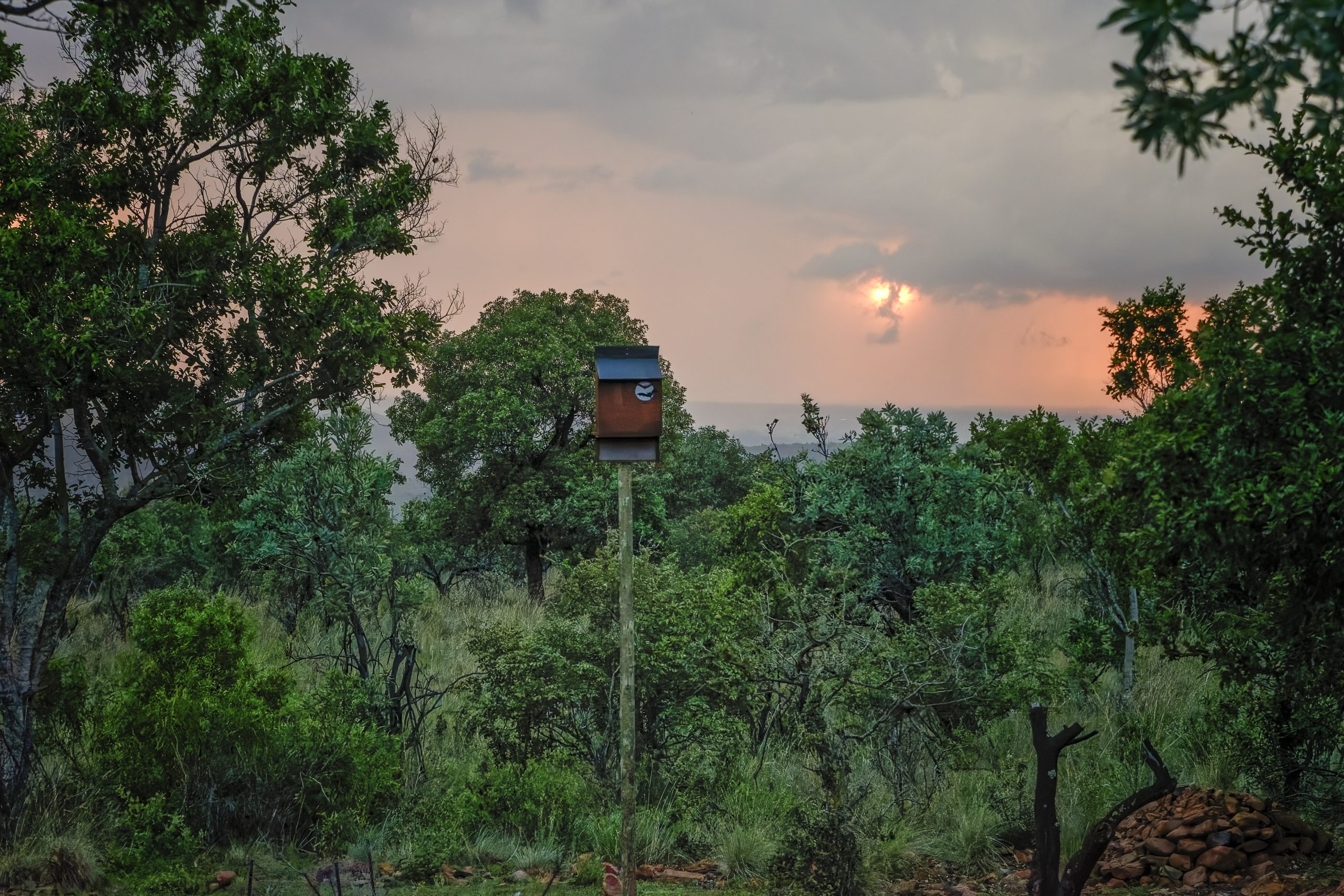
BAT HOUSES
FROM: The South African Bat Assessment Association "In Africa, as in other parts of the world, bats provide essential ‘ecosystem services’. Insectivorous bats provide essential services through maintaining a healthy ecological balance by means of natural insect control. For example, in sugar cane monocultures in Swaziland, two species of molossid bats selectively foraged over sugar cane fields rather than over natural vegetation. In the same area, based on next-generation DNA sequencing from faecal pellets, several local pest insect species (including the borer moth, Eldana saccharina) featured in the diet of these species. Based on next-generation DNA sequencing results, five out of six bat species tested in macadamia orchards in a Limpopo study contained DNA from the major pest of macadamia, green vegetable stinkbugs (Nezara viridula). Seasonal activity of bats foraging in these same macadamia orchards was correlated with the annual cycle of two stinkbug pest species. Stinkbugs of the Family Pentatomidae result in damage of up to R50 million per year in South African macadamia and avocado orchards. Bats also play an important role in social health by combating disease (e.g. malaria). Frugivorous bats provide seed dispersal (thus aiding forest regeneration) and pollination services."
Building a bat house is a bit more intensive than building an owl house. Contact Eco Solutions. They also sell and install bat houses. Use the same link above.